





Rebates are designed to help your funding work harder.
For eligible customers, rebate value can accrue when money stays within the Sonovate platform for longer. There are two main ways to do this:
- Use supplier or worker deferrals: where agreed terms allow, you can schedule certain supplier or worker payments for a later date rather than paying funds out immediately.
- Retain margin in your Wallet: instead of withdrawing available margin by default, you can keep it in the platform until the business actually needs it.
The aim is not to slow your business down or delay payments unexpectedly. It is about being more intentional with when money moves, why it moves and whether it needs to leave your Wallet straight away.
That could mean setting clear payment terms with suitable workers, keeping VAT or margin in your Wallet until bills are due or using Sonovate to fund perm invoices so more cash can stay in the platform.
The longer eligible funds remain in the Sonovate ecosystem, the more opportunity there is to increase your potential rebate value.
1. Use supplier or worker deferrals where terms allow
Deferrals allow you to schedule certain supplier or worker payments for a later date.
Instead of money leaving the platform as soon as funds become available, the payment is scheduled in line with agreed terms. During that time, eligible funds remain in the Sonovate ecosystem and may continue to accrue rebate value.
Worker deferrals are only available where you run timesheets through Sonovate. PAYE payments cannot be deferred.
This works best when payment terms are clear, agreed upfront and suitable for the type of worker or supplier being paid.
For example:
- Timesheets are submitted and approved by Monday
- Payment is scheduled a few days later
- The worker is still paid within the same week
- The funds remain in the platform for longer
- Your business increases its potential rebate value
The key is predictability. Deferrals should not be used to surprise workers or move payment dates without clear communication.
Interested in using worker deferrals? Speak to us about running timesheets through Sonovate and activating the right setup for your business.
2. Be clear on which workers are suitable for terms
Not every worker group will be right for deferred payments. The right approach depends on the type of worker, their expectations and the way they usually manage their income.
PAYE workers should be excluded from this approach, as PAYE payments cannot be deferred.
Where payment terms may be expected
Payment terms may be more suitable for:
- Limited company contractors
- Suppliers already used to invoice based payment cycles
- Higher earning contractors who are comfortable with agreed terms
- Workers on longer assignments with predictable timesheets
- Specialist contractors who treat their engagement more like a business relationship
For these groups, agreed payment terms may already feel familiar, especially if they are set before the placement starts.
Where payment terms may not be suitable
Payment terms may be less suitable for:
- PAYE workers
- Lower paid workers who rely on immediate cashflow
- Short term or high volume temp workers
- Workers in sectors where same week payment is a major expectation
- Any worker group where changing payment timing could damage trust
The aim is not to apply one payment model across everyone. It is to identify where terms make sense and where faster payment should remain the priority.
3. Give workers a reason to accept terms
If suitable workers are being asked to accept different payment terms, the value should be clear to them too.
You could consider offering workers their own benefit in return for accepting agreed terms, such as:
- A slightly better rate
- Priority access to certain roles
- A loyalty bonus after a set number of completed weeks
- Clearer payment visibility
- A choice between standard terms and faster payment
The strongest approach is choice. Some workers will always prioritise speed. Others may be open to terms if the reward is clear and the process is reliable.
4. Build a simple weekly rhythm
Rebate optimisation works best when it becomes part of your normal operating process.
A simple example could be:
- Monday: Timesheet submission and approval deadline
- Tuesday: Review funding and Wallet balances
- Wednesday: Confirm scheduled payments
- Thursday or Friday: Worker payments land, depending on agreed terms
- Month end: Review rebate value and identify improvement opportunities
This creates a predictable process for your team and your workers, while helping eligible funds stay in the platform for longer.
5. Retain margin instead of withdrawing by default
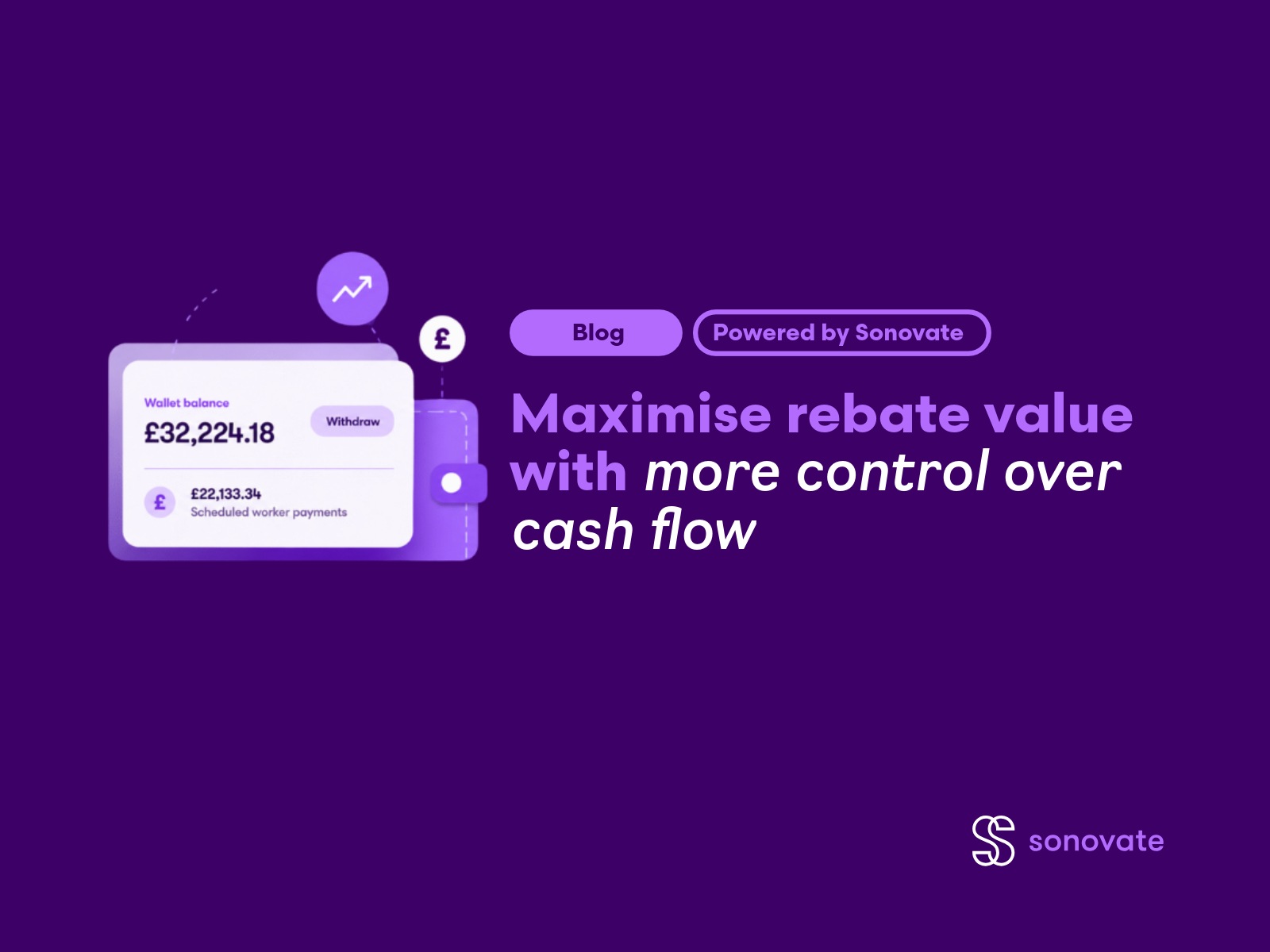
Retaining margin means keeping your available margin in your Sonovate Wallet until the business actually needs it.
Instead of withdrawing money as soon as it becomes available, you can leave it in the platform for future costs.
For example, you may choose to retain funds for:
- VAT bills
- Payroll runs
- Supplier payments
- Internal cost cycles
- Month end cash planning
- Future investment or growth activity
The principle is simple: only move money out when you need to.
If the money does not need to leave the platform today, keeping it in your Wallet can increase the time it remains eligible for potential rebate value.
6. Keep VAT in your Wallet until the bill is due
VAT is a good example of money that may not need to leave your Wallet immediately.
If VAT is being set aside for a future bill, keeping it in your Wallet until it is needed can help you maintain control while increasing the time eligible funds remain in the platform.
The important point is discipline. VAT should still be ringfenced, tracked and paid on time. The opportunity is not to spend it elsewhere. The opportunity is to avoid moving it earlier than necessary.
7. Use partial withdrawals
You do not always need to withdraw everything at once.
Partial withdrawals allow you to take the money the business needs now, while leaving the rest in your Wallet for longer.
For example:
- You have margin available in your Wallet
- The business only needs part of it this week
- You withdraw what is needed
- The remaining balance stays in the platform
- You increase the opportunity to accrue rebate value
This is a simple way to balance cash access with rebate optimisation.
8. Fund perm invoices through Sonovate
Perm revenue can create useful cashflow opportunities.
Where eligible, funding perm invoices through Sonovate can help you access value sooner while keeping more money in your Wallet until the business needs it.
This can be especially useful if you want to:
- Reduce reliance on operating cash
- Keep more liquidity available
- Smooth cashflow around larger perm fees
- Retain funds in your Wallet for longer
- Use rebate value as part of your wider funding strategy
Instead of perm income landing and leaving immediately, your Wallet can become a more controlled cash management layer.
If you are not set up for funding perm on Sonovate, click here to talk to us about getting it switched on.
9. Avoid unnecessary withdrawals
Before withdrawing funds, ask:
- Is this money needed today?
- Is there a bill due now?
- Could this stay in the Wallet until the payment date?
- Would a partial withdrawal be enough?
- Are we withdrawing because we need the cash, or because that is what we have always done?
Small behaviour changes can add up. Even holding funds for a few extra days can increase potential rebate value over time.
10. Review your customer and worker mix
The best rebate strategy depends on your agency’s operating model.
Useful areas to review include:
- Which workers could reasonably move onto agreed terms
- Which workers should remain on immediate or faster payment
- Which clients create the largest margin opportunities
- Which invoices produce the largest retained margin
- Which payments leave the Wallet earlier than they need to
- Which business costs could be aligned to scheduled withdrawals
This helps you move from a generic approach to a targeted one.
11. Make rebate value visible internally
If your team can see the impact, they are more likely to change behaviour.
You may want to track:
- Wallet balance over time
- Average number of days funds remain in the Wallet
- Total margin retained
- Deferred payment volume
- Monthly rebate value
- Missed opportunities where funds were withdrawn early
This helps finance, operations and leadership understand how everyday payment decisions affect rebate value.
The key principle
To maximise rebate value, focus on three simple behaviours:
- Keep eligible funds in your Wallet for longer
- Use agreed supplier or worker payment terms where they fit
- Withdraw based on need, not habit
The best approach is not to delay everything. It is to move money with more intent.
That means paying workers fairly and predictably, keeping business funds available until they are needed and using Sonovate Wallets to make your funding work harder.